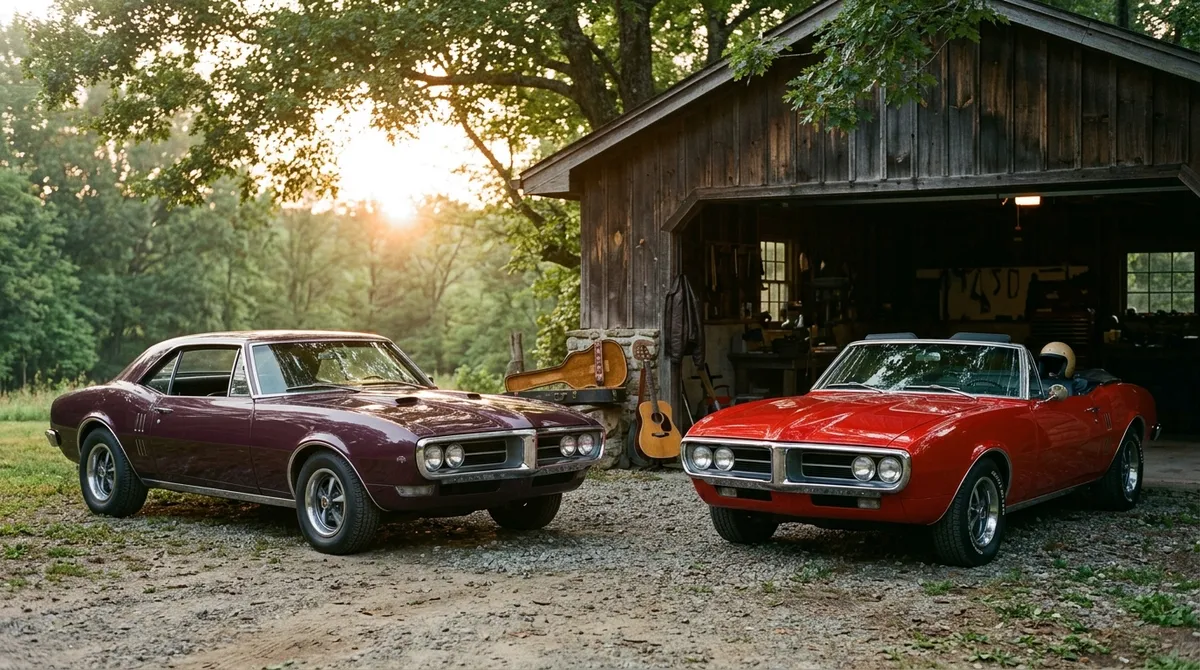
Grammy-winning musician Julian King wakes up before sunrise, opens his garage doors in Tennessee, and gets to work. Not on music — on two 1967 Pontiac Firebirds. One is a red convertible. The other is a Plum Mist Ram Air 400 coupe. Different body styles, same model year, same owner, and together they make a pretty compelling argument that the Firebird has been living in the Camaro's shadow for far too long.
King's story, reported by Autoevolution, is personal and specific in the way great car stories always are. But it also points at something broader: the collectors and enthusiasts who look past the obvious choices tend to find something more interesting on the other side.
The Camaro Gets the Glory, the Firebird Gets the Character
The 1967 Camaro is one of the most recognized first-year muscle cars ever built. It launched to enormous fanfare, and the collector market has priced it accordingly. Clean first-gen Camaros — especially convertibles and Z/28s — regularly command serious money at auction.
The 1967 Firebird debuted the same year, on the same basic F-body platform, and it has never quite gotten the same spotlight. That's partly a branding story — Chevrolet moved more metal than Pontiac — and partly just the peculiar logic of collector markets, where the bestseller often sets the ceiling on desirability.
But spend any time with a first-gen Firebird and the differences feel meaningful, not cosmetic. Pontiac gave the Firebird its own distinct nose, a more upright and sculpted front end compared to the Camaro's flatter face. The interior treatment leaned slightly more toward the driver. And crucially, Pontiac offered its own engine lineup, including the Ram Air 400 that King's coupe carries — a 400 cubic inch V8 with forced-air induction straight from the factory. That's not a Camaro with different badges. That's a car with its own engineering personality.
Two Body Styles, One Model Year — Here's Why That Matters
King didn't stumble into owning two Firebirds. Owning both a convertible and a coupe from the same year is the kind of decision that reflects genuine depth of interest in a specific car. Each body style tells a different side of the story.
The convertible is the car you drive with the top down on a Saturday morning when the roads are empty and the air is still cool. It's looser, more social, meant to be seen. The 1967 Firebird convertible production numbers were lower than the coupe to begin with, which means surviving examples draw real attention at shows.
The coupe — especially a Ram Air 400 car — is the performance story. Closed roof, stiffer structure, and a drivetrain spec that was built for people who wanted the Pontiac powertrain in something lighter and more athletic than a GTO. The Ram Air system fed cooler, denser outside air to the carburetor, giving the 400 a real performance advantage over a standard-induction engine of the same displacement.
Owning both means King has the full picture of what 1967 Pontiac could do with the Firebird concept. That's not redundancy — it's range.
The Morning Ritual Is the Real Story
What Autoevolution's profile captures that specs alone can't is the rhythm of King's relationship with these cars. He's up before dawn. The garage doors are open. He's wrenching before most people have had coffee.
That detail matters because it reframes what classic car ownership actually looks like at its most genuine. It's not always about weekend shows or auction results. For a lot of enthusiasts, it's closer to a daily practice — checking something, fixing something, just being near the machine before the day fills up with everything else.
King is a Grammy winner and a sound engineer by trade. Music and cars are both, at their core, about attention to detail and the willingness to keep working on something until it sounds or feels exactly right. The parallel isn't forced. Anyone who has spent an hour chasing an exhaust rattle or dialing in a carburetor knows that the process itself is part of the point.
Why the Firebird Fits the Moment for Collectors
The broader collector market has been shifting toward exactly the kind of car King owns. As the most famous first-gen muscle cars get priced out of reach for working enthusiasts, the interesting adjacent models start to look much smarter.
The 1967 Firebird sits in a genuinely appealing position. It shares parts compatibility with first-gen Camaro in many areas, which means the restoration and maintenance ecosystem is reasonably healthy. Pontiac-specific components have their own supply chain from specialty vendors. And the car's relative obscurity compared to the Camaro means you can still find good examples without paying Camaro-premium prices — though that gap has been narrowing as word gets out.
A Ram Air 400 car with documented provenance is already a serious collectible. A matching convertible in a striking color adds a different kind of value. King has both.
What Julian King's Garage Tells Every Enthusiast
You don't have to own two 1967 Firebirds to take something useful from this story. The principle is straightforward: the most rewarding cars in a collection are usually the ones chosen with genuine conviction rather than market consensus.
The Camaro is a great car. Nobody reasonable disputes that. But if what you actually love is the Pontiac engineering identity — the Ram Air intakes, the wide-track stance, the slightly different way the Firebird sits and steers — then buying the Camaro because it's the expected choice is a slow way to end up with a car you admire but don't love.
King chose the car he actually wanted, twice, in two different configurations. He works on them in the dark before the sun comes up. That's not an investment strategy. That's what it looks like when someone got it right.
If you've been watching first-gen Firebirds and talking yourself out of them in favor of something safer or more recognized, King's two-car garage is worth thinking about. The Camaro will always have its moment. The Firebird rewards the people who were paying attention.